We loved the TV ad where a girl gives virtual-reality headsets to her grandfather, a Vietnam-era fighter pilot, and his buddies so they can once again experience the joy of flight. (The pilots are real, not actors, and the short film encompassing the ad that Xfinity released for Military Appreciation Month is a must-see tearjerker.) Just how realistic is the VR experience, anyway? If you ask me, it’s pretty good.
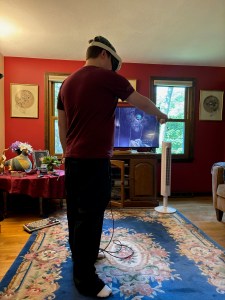
My youngest son splurged on a Meta Quest 2 virtual reality headset, and the other day he brought it, along with his tower PC, over to show it to us. To showcase the experience, he brought Riven, the great Cyan game originally released in 1997, now replatformed for Meta Quest. My son and I played Riven together when he was young—well, mainly I worked through the answer book while he sat in my lap and watched—so he thought it would be familiar to me. He walked through the familiar game landscape while I watched what he “saw” on our TV, and then he put the headset on me so I could explore while he monitored my progress and coached me.
Back to the island
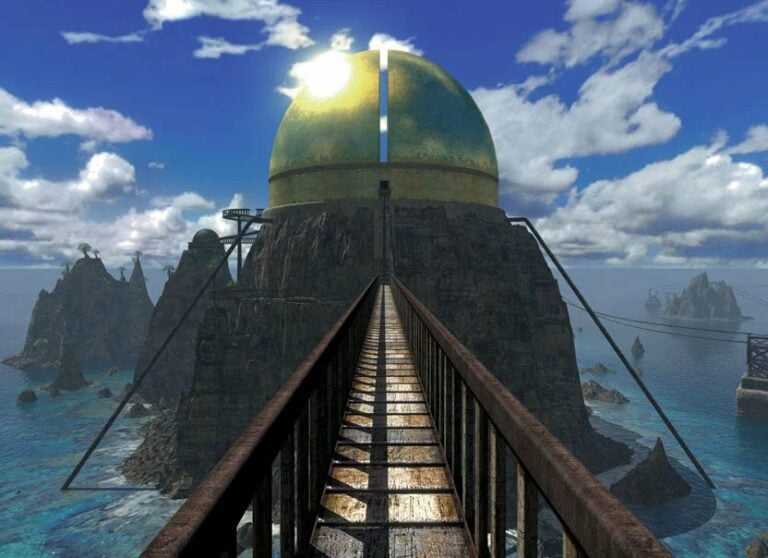
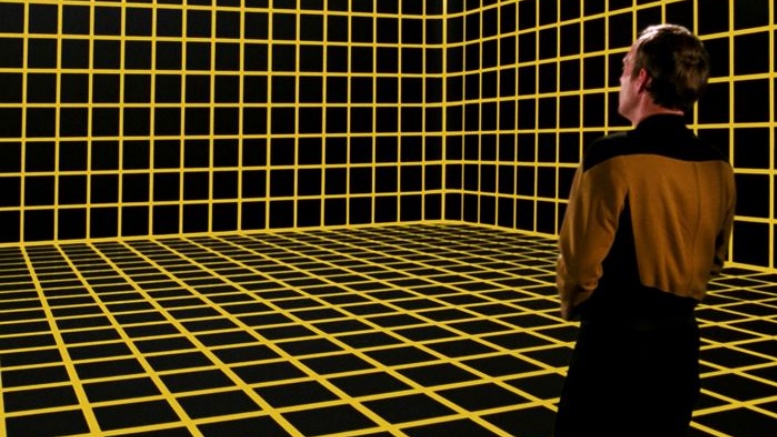
Without getting into the details of Riven, you are transported to a small island and must solve physical puzzles to escape it. The game is untimed, so you can fully explore the island and its mysterious structures at your leisure. The VR headset provides an immersive, high-definition, 360-degree view and positional audio; Riven implemented full three-dimensional views everywhere, from straight up to straight down and all the way around. When you move your head or take a step, your perspective changes, so you can literally look at and walk through the entire virtual space. (Tip: don’t turn around rubbernecking so much that you wrap yourself up in the cord.) The system maps out your physical locale—in this case, our living room—and your position within it, and alerts you visually, rather in the manner of a Star Trek holodeck, before you walk into your couch.
To let you manipulate objects in VR space, the headset comes with hand controllers, analogous to computer mice, that serve as your VR hands. You can reach out and touch objects in virtual space, and also click buttons to move forward virtually without taking a step, the way Riven used to let you click on an image to move toward it.
Riven provides detailed rendering, as impressive as when Cyan first introduced it, but now in 3D and moving. I found myself marveling at tufts of grass blowing in the sea breeze and gawking at birds overhead that had nothing to do with the game. Once I started exploring the island itself, the VR effect was so realistic that it triggered physiological reactions. If I moved my head abruptly or clicked forward too rapidly it made me slightly queasy. When I physically walked to the edge of a cliff to look down at a game element my body involuntarily flinched, and my son had to reassure me that the game wouldn’t let me fall off. (Had I tripped over the cable at that moment I don’t know how I would have reacted—probably spasmodically!)
In my experience, whenever I’ve been exposed to a new level of display detail, I’ve thought it looked “real,” until I saw the next breakthrough. Despite its remarkable verisimilitude, there are limitations to the VR system. I won’t say the Riven island looked real, and when the next next generation of graphics rendering hardware comes out the effect will probably look quaint, but to my eyes it quickly became acceptably realistic. Rendered on my son’s computer, I could move more quickly through the virtual environment than the system could paint the image, so some sights (such as a footbridge I was crossing) appeared ahead of me only after a lag.
A VR headset packs a lot of hardware, so while “touring” the island I never lost the sense that I was wearing one, the way I often forget I”m wearing glasses. The headset is bulky, not light, and the aforementioned cable can get in the way if you physically move around. It’s easy to get the hang of the controllers, but I believe another company makes glove controllers, which would track both hand and and finger movement. That sounds better.
What else have you got?
VR is a leap forward in realistic gaming. I expect a first-person shooter game where you could see a sniper on the roof and hear a gun being cocked on your left would be entirely convincing. A VR racing game, even played from the comfort of your chair, must be thrilling. But gaming not my pastime, so I won’t endorse any of the dozens of VR games currently available. (Current roundups are available here and here.) I’m also not endorsing the Meta product; VR systems are available from Apple, PlayStation, and others.
VR experiences other than gaming are available. Even something familiar like Google street map view would be transformed as a VR experience. But let’s think bigger. A VR experience good enough to fool your body enables physical exercise in virtual space. VR is unconfined by space, time, or reality, so the possible venues are unlimited as well. If tourist attractions bore you, how about the depths of the ocean or the reaches of outer space? NASA has more than enough photographic data to create VR tours of the International Space Station, the lunar surface, and Martian landscapes. If the present doesn’t appeal to you, how about the Jurassic Era? And anyone willing to invest the effort can create an entire fantasy world, like Riven, or a universe, like No Man’s Sky.
Virtual travel for the no-go years
My wife and I have reached the “go-go” stage in our lives, where we’re willing and able to explore new places. We know people who are in their “slow-go” years, willing to travel but limited by financial or medical constraints. Even where we can go, we risk becoming part of a noisome and increasingly unwelcome throng. We’ve been to the Great Wall of China as part of a crowded that looked and sounded like we were filing out of a stadium. Ecologically fragile Venice now restricts cruise ships and tourists. You need a timed ticket to visit the Louvre. Our own window of opportunity is closing.
How marvelous it would be to have VR recordings of tourist attractions—the Great Wall, the Pyramids, the palace at Versailles, Rome, London, Venice, the Smithsonian, the Louvre—that even someone in their “no-go” years, confined to a bed or wheelchair, could still visit and tour at leisure without fighting a crowd, a staircase, or a clock. It would be much more cost-effective and eco-friendly than a flight or a cruise. If more people were satisfied by touring virtually rather than physically, the crush in the real world would be reduced as well.
The bottom line is that my brief exposure to VR was intriguing, and I’ll be interested to see how the field develops. As a hard-core Apple guy, I know Apple Vision Pro is a top-of-the-line system for only ten times the price. Hmm., it’s nearly my birthday…
 Steven Jong
Great article Steve, thank you for your insights and ideas.
LikeLike