I wanted to be a pilot when I grew up until my eyes went bad. Fortunately, I got top grades on my writing homework, and eventually, I found adequate employment. But I’ve retained my interest in aircraft and flight all these years and passed along some of that interest to my oldest son. For his birthday this year, I booked him time on a Boeing 737 flight simulator and booked some for myself. We had a great time, and if you’re ever in Canton, Massachusetts, I highly recommend you experience it yourself.
The simulator reproduces the flight deck of a 737NG in exact working detail, good enough for pilot training. High-definition video synchronized to the controls is projected outside the windows, and sound effects, such as the engines revving up and down when you work the throttles, add to the realism. Even though the simulator doesn’t move, the overall effect is so convincing that when I climbed and banked away from the runway, I felt it.
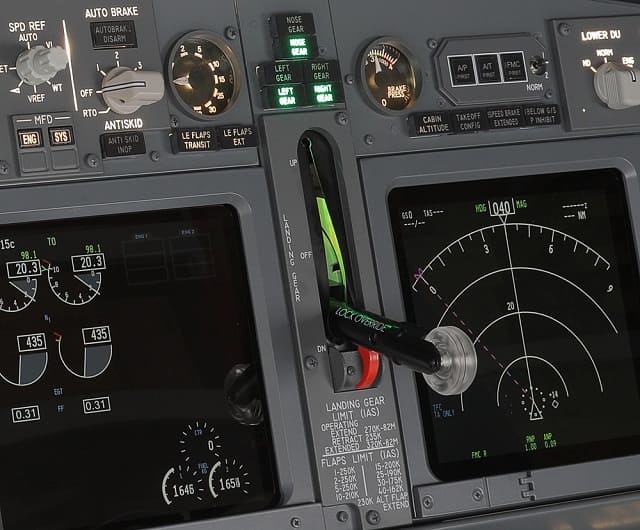
A “co-pilot” who’s really a certified flight instructor sat in the second seat and patiently took me through the flight plan. He used a long pointer and a laser pointer to draw my attention to which display, knob, lever, or dial to look at or manipulate in an overwhelmingly complex layout.
To give you some idea of the simulator’s flexibility, I chose to take off from Denver, climb west over the Rockies, and land in San Francisco. I managed to get the plane off the ground, avoid hitting mountains, and land in one piece. (I have the video to prove it.)
The 737NG is a highly computerized aircraft. Most of the flight is controlled by the autopilot, so “flying” consists almost entirely of setting and changing altitude, speed, and direction by turning knobs. That much I could do. Of course, the manual portions include takeoff, landing, and troubleshooting. The instructor programmed into my simulated flight a couple of anomalies to deal with: approaching traffic (another plane on a collision course, visible first on radar and then visually, that I had to maneuver around) and a smoke alarm in the forward lavatory (don’t even think about trying it). My son, who was more proficient, got hit with an engine failure and a stuck landing gear. Yikes! The flight crew draws a salary not just for knowing how to twist a knob but also for knowing how to deal with emergencies.
Earning My Pilot’s Certificate
Today, my corrected vision is better than 20/20. If I wanted to come out of retirement, totally change careers, and become an airline pilot, what would it take?
To become a certified pilot, you must demonstrate at least a minimum level of knowledge, skill, and ability (KSAs). To begin with, the knowledge required to operate, maintain, and repair a modern jet aircraft is immense. In addition to a minimum of 500 hours of classroom training, candidate pilots must pass a series of written tests, oral examinations, practical exams, and stage checks, including three formal exams given by the Federal Aviation Administration, followed by a practical test. Along the way you must earn six levels of certification from private pilot to airline transport pilot.
The fundamental skill of stick-and-rudder flying is unlike anything I’ve ever done. It absolutely can’t be taught by books, only by lengthy practice. Unlike driving, flying is three-dimensional. If you don’t want your passengers to feel like they’re riding on the back of a dolphin, you need to change both direction and altitude smoothly. Qualifying as a Boeing 737 pilot requires, at a minimum, 2000 hours of flight time on increasingly large aircraft. That’s a full-time year spent in the air. But before that, just trying to taxi from the simulator gate to the runway brought back my first driving lesson, which, as I recall, went badly. (Imagine you’re on a giant tricycle with the front wheel located behind and below you and controlled by a wheel by your left hand.) Our instructor told us consolingly that pilots book hours of time on the simulator just to practice taxiing.
Life-and-Death Interface Design Decisions
During World War I, men who sometimes had never even driven a car were taught the skills of flying: trusting their instruments when blinded by clouds or fog, marksmanship when aiming meant turning the whole plane, and keeping their engine running in different conditions and after gunfire damage. In World War II, people who might or might not have had flight experience were taught to fly multi-engine planes, a huge jump in complexity that brought its own problems. The four-engine Boeing B-17 bomber was complex but seemed like a pilot’s dream: every pertinent measurement was displayed in the cockpit, and every function was controlled by switches. But once deployed, planes were lost to inexplicable pilot errors such as raising the landing gear before landing instead of lowering the flaps. Was the pilot training inadequate?
Early designers (whom today we would call human-factors engineers) considered their users: young pilots, physically and mentally drained after flying ten-hour missions under fire much of the way, who were expected at the critical end to correctly choose between two identical switches placed next to each other. To distinguish them, designers changed the controls to levers with different labels, locations, colors, and shapes corresponding to their functions. After this design change, B-17s flew 1.8 million miles with no pilot confusing the two levers. To this day, Boeing designs those controls the same way: The flap control has a handle shaped like a wing, and the landing-gear lever has a literal wheel on it. To lower the flaps or the landing gear, you pull the levers down.
By the way, the engine instrumentation of a two-engine 737 is complicated, and for the B-17 was twice as complex. But from 1949 to 1959, the US Air Force deployed the B-36, a massive, transitional ten-engine bomber with six propellers and four jets (“six turning and four burning”). The flight engineer’s job on that aircraft was daunting. Even the dials had dials!

Close Attention to Documentation is Required
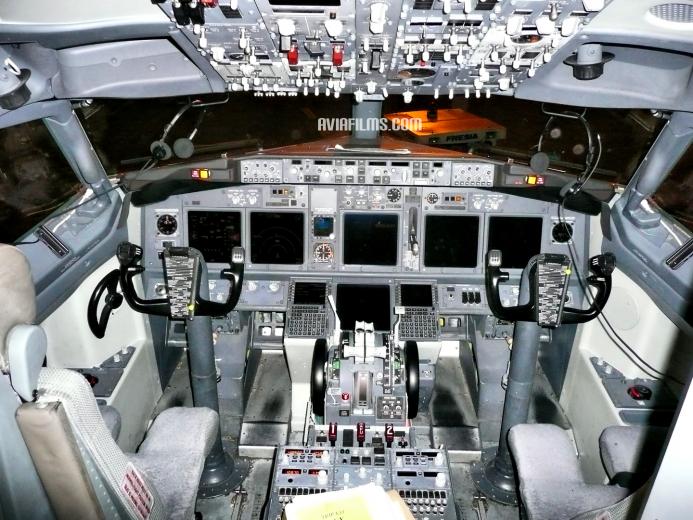
Another innovation that came from the study of B-17 pilot errors was the checklist. No matter how well flight crews were trained, during critical moments of the flight there were simply too many things to do for them to remember. Checklists reminded them. In The Checklist Manifesto: How to Get Things Right, Atul Gawande writes about the pioneering development and use of checklists for the B-17. You can see checklists mounted on the yokes in the 737 cockpit photo above. Today, checklists help ensure the completion of complex operations in many fields, and they are familiar to all technical communicators.
Before my “flight,” I saw and purchased a 99-cent 737 checklist, which turned out to be the bare-bones list of takeoff, flight, landing preparation, and landing items that the instructor took me through verbally. (I was happy to pay a buck for a technical document.) There were still some 60 items total.
In addition to that checklist, I searched the web for 737 documentation and quickly found (but did not read) a flight crew operations guide (1,826 pages), a technical guide (374 pages), and a quick reference handbook (402 pages, which should tell you something), all highly controlled documents. I don’t think I found the full doc set. Of course, today’s pilots carry the necessary documentation on tablets.
The aircrat hardware is also documented. The history of every part of the airframe is recorded from manufacture to replacement, including maintenance logs. As a result, the documentation for the Boeing 747, printed out, is said to weigh more than the plane itself.
My Dream of Flying Comes Down to Earth
I may have the ability to fly an airliner level and land it without bouncing, but I’m years behind the curve in acquiring the requisite knowledge and skills to work as a pilot. For everyone’s sake, I’ll stick to passenger seats and simulators.
 Steven Jong