Yesterday, 29 January 2025, the STC Board and Executive Director sent notice to members, stakeholders, and friends that “effective immediately, STC will permanently close its doors and cease all activities.” The title of the message was “The Future of STC,” but the message was that the future is null.
Today, many colleagues are posting messages and blog posts reacting to STC’s abrupt end. Their reactions mostly take the form, “As an [n]-year member of STC and [activity] volunteer, I am [reaction] to see it go.” Here’s my reaction, but I thought I would parse it to offer some useful information and context.
This announcement is predictable but sad. As a 42-year member who joined the Society in 1982 (and had just renewed), Fellow, chair of the first Certification Commission, President’s Award winner, and two-time president of the Boston Chapter—a founding chapter of the Society—I am bummed.
This announcement is predictable but sad.
Who could have seen this coming? Um…
Here is the year-over-year membership data over the last 30 years. As far as I know, the absolute peak membership of the Society was just over 21,000 in the spring of 2002, but declined steadily every year after that. I suspect 2025 would have seen membership drop under 1,000.
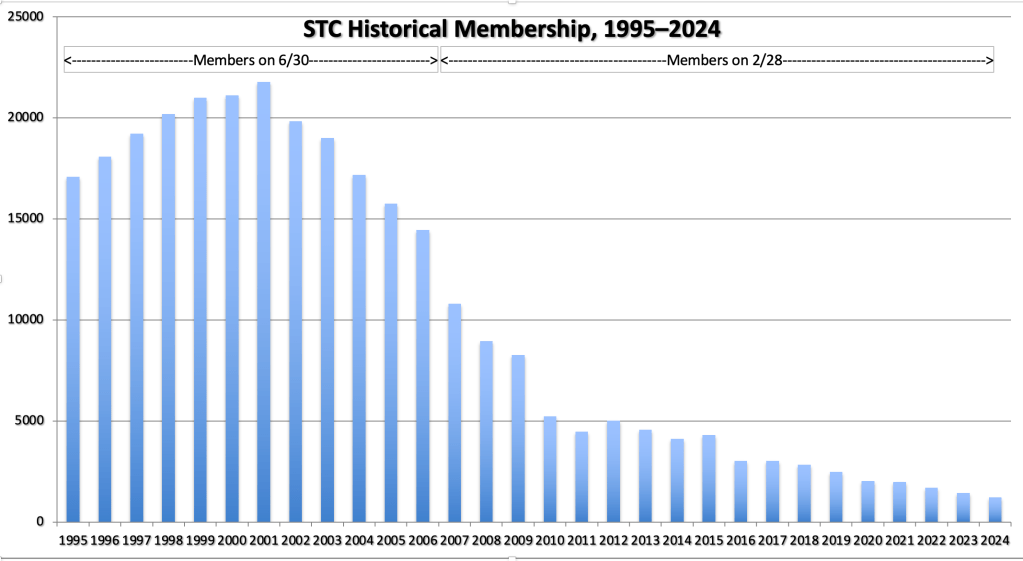
Note: This data is discontinuous. Before 2007, it was the membership at the end of the STC fiscal year on 30 June. From 2007 on, as the decline reached 50%, STC, perhaps understandably, stopped disclosing its membership to members. From then on, I used the membership data announced yearly by the STC election teller on 28 February. I believe the apparent membership drop you see for 2007 is an artifact of that change, but the data on either side is comparable.
As for my personal reaction, I have been a second-generation technical writer. STC was my professional home across a career spanning ten companies. STC members mentored me. I got jobs directly through STC networking. I invested considerable effort giving back to the Society over the years: judging scores of entries in the Boston, Alliance, and International Technical Publications competitions; writing many papers and presenting many times at the chapter, regional, and Society levels; serving at the chapter and Society levels; and mentoring dozens of rising practitioners. (I still have one I intend to keep working with.) I made lifelong friends. Of course I’m sad.
As a 42-year member who joined the Society in 1982 (and had just renewed),
I contacted the information address on another matter and received an automatic reply that addresses members’ likely top question: “Some of you are requesting dues refunds. The trustee appointed by the bankruptcy court will be reaching out to all dues paying members over the next few weeks with information and options.“
Board member (2007–2010),
I’ve already seen someone dance on the Society’s grave by blaming its demise on “years of mismanagement and bad decisions.” Well, I served on the Board, and to take the Board line, I supported its decisions, so I will stand up and accept my share of blame. But look at the data. Who would you blame for a 25-year membership decline? I assure you that this issue was at the top of the minds of every STC president, board member, and executive director the whole time. If the number of members hasn’t been the top KPI at the Society level it should have been. It’s been mine for 20 years.
I can also say that when I served on the Board, we blamed the decline after 2001 on the aftereffects of the events of 9/11, and that membership would recover. We were wrong about that. But if you look at the membership of other professional associations, this trajectory is not unique. The underlying issue is bigger than just STC. The final Board didn’t screw up; my Board didn’t screw up; the 2001–2002 Board didn’t screw up. Maybe we can blame Osama bin Laden, but I don’t think we can pin it even on him. I blame demographics, but what do I know?
Fellow,
A professional society fellowship is a lifetime honor, so when I received it in 2018 I told myself that even if I stopped paying dues I would remain a fellow for life. I didn’t anticipate outliving the Society, but I’m keeping my plaque.
chair of the first Certification Commission, President’s Award winner,
One of the first certificants told me at an STC Summit that he’d received a transformative raise from his employer for getting certified. When I came home and told my wife, I burst into tears. Why? Along with a volunteer task force, committee, and commission, I worked full-time for five years years getting the certification program approved and operational, but it changed peoples’ lives for the better. Receiving the President’s Award, in recognition of those efforts and on behalf of many others who contributed, was a signal honor and genuinely one of the happiest moments of my life.
I’m gratified that the STC Certification program today has over 760 certificants. I hope that the program continues, because it’s an ongoing benefit to certificants, employers, the profession, and the public.
and two-time president of the Boston Chapter—a founding chapter of the Society
STC was founded in 1952 by two organizations of technical writers and editors, one in Boston and one in New York. We in Boston were always conscious of our historical role and position in the Society. Our last few Chapter presidents and officers served multi-year terms and deserve thanks for their efforts.
To chapter leaders, who may have been feeling lost and bewildered by their membership decline: you are not alone and not to blame for what’s happened. Take it from someone who’s seen STC volunteers for over 40 years: you and other volunteers have worked just as hard as anyone ever has for the benefit of your members and the Society. It’s just a damned shame that you’ve been left literally holding the bag.
—I am bummed.
I am predictably and deeply bummed out. STC was a big part of my life. STC was very, very good to me, and I’m sorry to see it go.

STC was very, very good to me
 Steven Jong