The unboxing phenomenon lets us vicariously enjoy the process of receiving and opening a new product by watching videos posted by other people. Unboxing videos are very popular: Unbox Therapy has over two million YouTube subscribers, and this video garnered over two million views in less than two weeks.
There’s a sensuous feel to unboxing videos, because some products are elaborately packaged. We may never even get our hands on some of them. For example, “Weird Al” Yankovic posted a video of him unboxing his 2015 Grammy award for “Mandatory Fun.” (Vicarious and hilarious!)
Another class of video involves instruction on or demonstration of product installation and setup. Just as we once watched Julia Child or Bob Ross show us how to do things we didn’t know how to do, we can watch these videos to learn how to install or configure complex products. As someone who makes a living in part describing how to install and configure products, I’m interested in unboxing videos, and more so in installation videos. They give us a direct view of how consumers open, install, and set up products. It’s particularly relevant to consumer hardware, but software videos are increasingly available, and we can learn from them as well.
This Unbox Therapy video shows the unboxing and setup process for an Apple Watch. The effort Apple puts into their packaging is appreciated in at least some quarters (as of this writing the video has been viewed nearly two million times on YouTube).
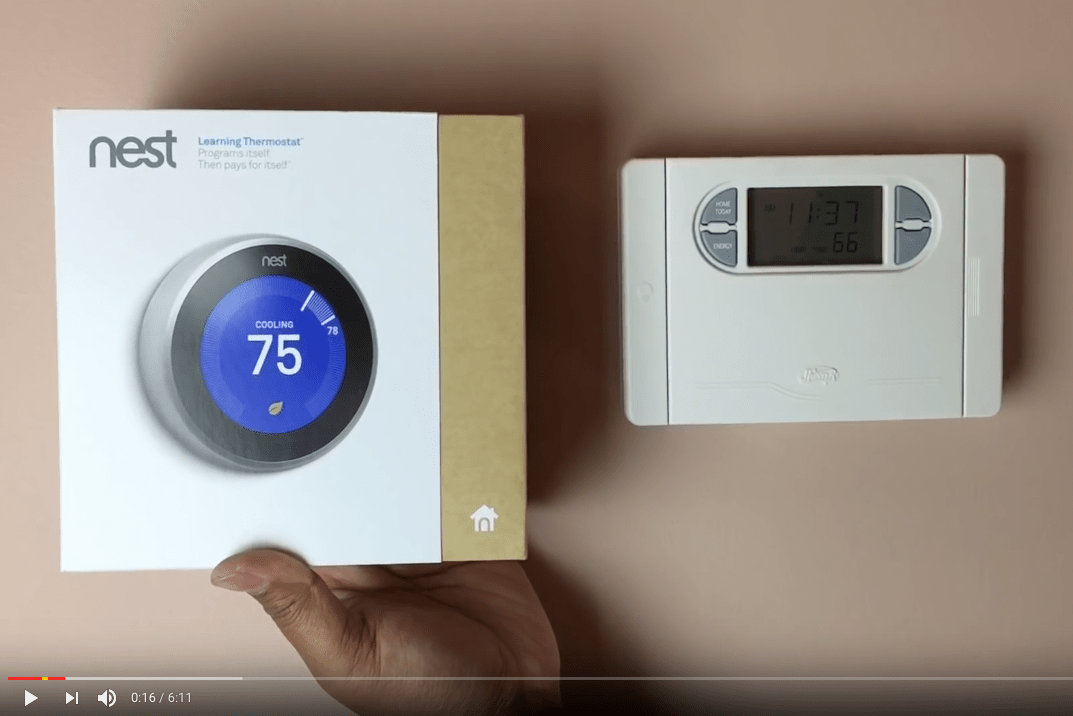
Unboxing and setup video for a Nest Learning Thermostat
This video shows the installation of a Nest thermostat. If Nest is smart—and I’m sure they are!—they’ve carefully analyzed this and other third-party videos involving their products. Why? First, although the “official” Next installation video is also on YouTube and more popular (viewed over 420,000 times as of this writing), the unofficial one has still garnered over 46,000 views as of this writing, and if it’s inaccurate, it could cause problems for the company. But also, even if it’s accurate, seeing how the product is installed from scratch in the real world by a real customer provides invaluable information. Many of us have had the experience of opening and assembling a laptop computer with both hardware and software components, developed separately and perhaps tossed into the same box. (There’s a story from DEC about a system that was shipped in one crate, but with three separate documents labeled “Read Me First.”) It’s a good idea to audit a first-time user’s initial experience, and an unboxing video affords us that opportunity. Installation procedures are painstaking, and usually we only have the energy to document the mainline, everything-works procedure. How much better the instructions would be if we knew of, say, the ten most common user errors and could head them off!
Chosen at random, here are two third-party videos of software installations. In Microsoft Dynamics CRM 2016, an experienced installer encounters and calmly works through multiple issues in this complex installation that might otherwise halt the process and trigger a support call. In Windows Server 2012, the installer walks through a maze of decision points that would make my head hurt trying to describe (but in this case the video might benefit from the time-compression techniques employed in “The French Chef”).
As technical communicators, then, what can we learn from unboxing videos?
That they may exist for our products right now, and that our customers may be using them
How our product is actually packaged and shipped, and how our customers deal with unboxing
How customers actually install and set up our products
How long steps take
Where points of confusion or error arise in the field
I hope you’ve received some nice products this holiday season and are enjoying unboxing them!
If you are a current STC member, I have a personal favor to ask. I ask you to sign my nomination petition to appear on the ballot as a candidate for Director at Large of the Society in the upcoming Board election. As specified in Article VIII, Section 2, Part D of the STC Bylaws, I must collect some 600 member signatures in the next month to get on the ballot.
Why do I need to take this route? Well, I was vetted by the STC Nominating Committee, but not selected for the preliminary slate. You know my qualifications: I’ve served as an STC Director at Large and chairman of the Society’s first Certification Commission. I’m a 40-year practitioner, a 30-year member, an Associate Fellow, a past chapter president, and a President’s Award winner for my dedication and leadership. I have managed doc groups and led multiple non-profits. I have experience, and also a unique perspective as someone who understands STC both from top to bottom and from inside and out, and who can help effect the changes we need to survive and thrive.
Signing the petition does not commit you to voting for me in the election, but it does support my opportunity to serve you by letting me appear on the ballot. If I am so honored, I will campaign as a regular candidate. But I pledge to you that I’ll work as hard for STC this time as I have in my past roles—and as hard as I’m working right now to get that chance.
Emily Alfson, left, and Nancy Allison, STC New England Council volunteers, at the InterChange regional conference, April 2016. Emily organized this year’s conference remotely from Detroit. Nancy has been chapter president for two years.
April was National Volunteer Month, and, as it happens, when our chapter hosted InterChange, our regional conference. InterChange took a lot of volunteer work to pull off, and I have been thinking of late about STC volunteers. Like many of you, I volunteer time and professional services to STC, at both the chapter and Society levels. STC is careful to recognize the contributions of volunteers, and I’m not complaining. But there are ways to value volunteers—in every sense of the word—beyond simply thanking them.
This is a multi-faceted question. What is the value to an organization of a volunteer, as well as the volunteer’s work? Can a monetary value be attached to volunteer work? What is the value of a volunteer to STC in particular?
First, would you rather staff with paid employees or volunteers? Actually, each has advantages and disadvantages. You can direct employees, and influence their behavior through their salary. But once you agree on working hours, you can’t ask them to work nights and weekends. Volunteers do what they feel like doing, and can stop at any time. But a volunteer can agree to work nights and weekends, in general doing things that might otherwise not get done. So a mix of employees and volunteers, such as STC has, is a good thing.
Another way to answer the question is to estimate what it would cost to replace a volunteer with a paid employee doing the same task. Here’s an example. For a number of years the Boston (now New England) Chapter employed a professional accountant as a bookkeeper. We paid a regular stipend to cover a few hours of professional service. Now, you could argue (as some did) that we wasted our money—other chapters have tech writers as volunteer treasurers. Free beats paid, right? We thought so too, until our accounts became, shall I say, disorganized. (Our records were literally in a shoebox.) We reached a crisis point and needed professional help. The bookkeeper straightened everything out, and our records became immaculate. Over time, the bookkeeper assumed more and more roles with the chapter. Gradually this person became our program, workshop, and conference registrar; our vendor, sponsor, and venue liaison; and our contract negotiator; and all for the same stipend. Since her retirement it is taking us several volunteers to replace her. I say we got a bargain! Not only that: what is in shorter supply these days, money or volunteers?
As with paying a stipend, it’s possible to assign a direct monetary value to the work of volunteers. The accepted method is to track their hours and apply an average local prevailing-wage hourly rate. The overall US average non-farm employee costs $24 an hour for general labor (such as sitting at an event registration table). But specialized labor such as web design, and anything that creates or enhances non-financial assets, is figured at a prevailing local professional rate.
What’s the value of a volunteer to STC? STC is an international association with a professional staff and a multimillion-dollar budget, so how much of an impact could volunteers make? Actually, it’s quite significant. STC is hierarchical, run by a board and professional staff that sets direction and supports communities. But almost everything at the community level is done by, and so depends on, volunteers. This includes organizing and hosting local meetings, programs, workshops, and conferences; providing content for websites; running local competitions; putting on regional conferences; and other things we haven’t even thought of around these parts. For many members, STC is communities. For this organization, the impact of volunteers is magnified.
Can we quantify that impact? Let me run some (deliberately) very round and conservative numbers. If you want to play along, look up STC’s IRS Form 990, which is public information.
Today STC employs a staff of ten. The normal approximation of total compensation (salary plus benefits) in the US is roughly $200,000 per employee per year, but STC is very thrifty at about $120,000. (I’m not saying they all make $120K! A few do, but most don’t.) Not counting vacation time, a year’s labor is about 2,000 hours. So the STC staff annually puts in about 20,000 hours, and costs about $1,200,000.
STC claims 300 volunteers. If each of us donates 5 hours per month, then that’s 60 hours per volunteer per year. Using the general-labor rate of $24 per hour, that’s $432,000, and 18,000 hours, of donated labor per year.
So STC volunteers put in almost as many hours as the staff for a third of the cost (were we paying for it). Comparing the two sets of figures shows the relative magnitude, and value, of the work done by STC volunteers.
If anything, I underestimate. 300 volunteers works out to fewer than 3 per community. Hah! At one time the Body of Knowledge project organization chart listed 150 names. Five hours a month is a lot less than I, for one, donate. (How about you?) STC volunteers manage other volunteers, through Board-level committees, so the staff overhead for that task is low. And STC volunteers aren’t just staffing registration tables: we’re training each other through presentations, writing policies and procedures, designing websites, organizing events—all professional services. I think the actual number of volunteers, hours donated, and total value of donations are all higher than my rough estimate.
Whatever the figure, there are reasons for STC to valuate its volunteers. Generally accepted accounting principles cover volunteer services. From an accounting perspective, volunteer labor is both an expense and a revenue, so it cancels out. (Isn’t accounting fun?) However, listing volunteer hours also has the effect of reducing the relative size of other costs. The overhead of staff isn’t as great if you include the work done by volunteers. Doing so would improve our bottom line. Additionally, taking volunteer work into account would more accurately reflect the breadth and reach of the Society and amplify our impact. This matters to organizations that apply for grants; and corporations, foundations, and the US government offer various matching grants for volunteer hours to 501c(3) organizations.
While I’ve focused on value and valuation, recognition is also important. I think my casual analysis makes it pretty clear (if it wasn’t already!) that STC would have less impact, or perhaps wouldn’t even exist, without the efforts of hundreds of volunteers. Volunteers appreciate recognition, and tracking their contribution is a form of recognition. If their efforts are tracked, the magnitude of their contribution can be known. Organizations that track volunteer time can directly recognize those who put in the most.
So thank you for what you do for STC! Perhaps some day the organization will recognize your rightful status as a gold-star volunteer…
The STC New England InterChange regional conference was held 1–2 April, 2016 at the Inn and Conference Center of the University of Massachusetts Lowell. We had excellent attendance and we heard some great speakers and presentations. (We even had fine weather for our Friday evening perambulation to the Lowell Beer Works.)
The 2016 STC election is currently open. If you’re a member, you should have received a link to the election website (send email to stc@stc.org if you have not). It’s important to vote! The Society needs your active involvement. You can find out more about the candidates here.
One of today’s hottest technical trends is the Internet of Things (IoT). The idea is to network together physical objects containing electronics, software, and sensors on the Internet so they can collect and exchange data, offering improved efficiency, accuracy, and economic benefit. Each “thing” is uniquely identifiable through its embedded computing system (that is, by its MAC address), and can interoperate within the existing Internet infrastructure. Experts predict nearly 50 billion objects will be online within five years. The possibilities seem endless (here is a good rundown) and, frankly, a little bewildering.
My former colleague Wynn Grubbs, now senior vice president of business and partner development at PlumChoice, recently posted an article reporting that consumers “struggle to use common connected devices.” Talk about bewildering! Fully two thirds of consumers are “confounded” trying to install or use their purchases. When they need help, half the time consumers only ask friends and family; of those who turn to technical support, 80% are dissatisfied with the experience. Nor is the problem confined to older consumers: 60% of Millennials, the vaunted generation that literally grew up with computers, struggle with their own smart devices. (There is no mention of anyone turning to documentation.) One seventh of consumers eventually return their purchases.
That return rate (14%) is almost triple the return rate of consumer electronics in general, which is already too high. As I previously discussed, Accenture found that customers return 5% of consumer electronic devices because they “don’t work,” even though 95% of the devices returned actually work perfectly. Support, replacement, and restocking costs all reduce the profit margin, not to mention the cost of dissatisfied customers, who rarely come back. Returning items that work correctly is an expensive irony.
Now, the first generation of programmable devices featured unique hardware interfaces, and consumer acceptance was hit or miss. For example, I figured out how to use the brass springs and stops on my lawn sprinklers to water my grass but not my windows, but I know people who just let theirs spin. Smart devices are obviously much more complex and sophisticated than their “dumb” ancestors, with more functions but also more failure modes. The manufacturers’ instincts are to cram as many “smart” behaviors in as possible to justify the cost. A “smart” lawn sprinkler might be able to sense the actual rainfall and the state of dryness of your lawn, saving water and money by watering only when your lawn needs it (and sparing you the effort of going out and turning it on). Perhaps it can avoid watering at night, get the weather forecast from the Web, or use your community’s website to avoid watering during mandatory conservation days. There is probably an app that goes with it, so you can water the lawn from wherever you are. And perhaps it even has voice recognition, so if you say “the grass looks dead” (or “get off my lawn!”) it turns on. But such a device might fail to work altogether if the moisture sensor fails, if it can’t maintain a Wi-Fi connection, if the battery runs out, if a software update fails to install correctly, if the sprinkler’s CPU crashes, if the app fails, if you forget your account password, if it can’t make out what you’re saying, or even if the system is, however improbably, hacked. (Not to mention that running over it with the lawn mower just got a lot more expensive…) In the Internet of Things, where all devices are connected, a brown lawn might require you to buy a better router.
To get consumers to understand how to make sense of their smart devices, manufacturers have tried to make them as simple to use and autonomous as possible. However, this has only hidden their complexity and the potential problems behind a simplified GUI.
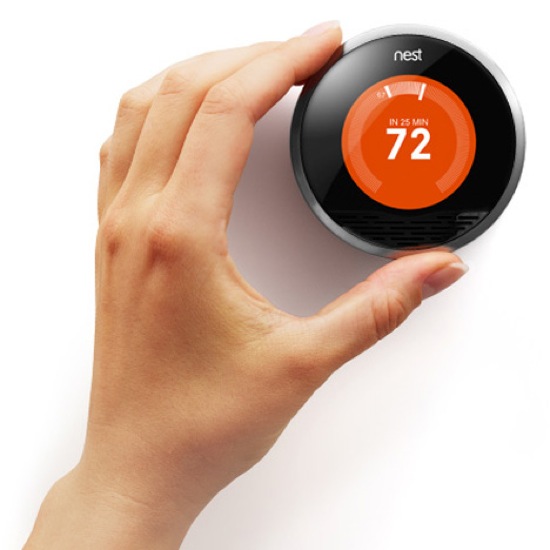
Smart devices, like this Nest Learning Thermostat, may look simple…… but they’re not
Now, understand that Wynn is offering his company’s support services to manufacturers. I wish him good hunting. But we too play the game of helping people successfully understand and use technical devices. (That’s how we make the world a better place.) What can we do? I see both front-end and back-end opportunities in the IoT.
Since the PlumChoice press release mentioned smart thermostats, and since I started my career at a company famous for its thermostats, I’ll take as a case study the Nest Learning Thermostat. (I don’t own a Nest and I’m not suggesting the product has any particular issues; in fact, Nest customer ratings on Amazon are very high.)
Back in the day, the “dumb” thermostat had one sensor and did one thing: turn on the furnace when the room temperature dropped below a set level. Then it learned to do two things: turn on the furnace when the house got cold and the air conditioning when it got hot. The second generation of thermostats was programmable, so that the temperature could be changed at specific times during the day and week: cooler at night to save money in winter, warmer during weekdays in summer while everyone was out. Home heating and cooling is a major component of home costs and energy usage, so if you’re willing and able to program one, a $50 thermostat will still save you money and energy and pay for itself very quickly. Why spring for a connected thermostat, then? The Nest business model is that consumers often can’t figure out, or can’t be bothered to closely program, their programmable thermostats. They’re right. As How-To Geek says in its product review:
You know what we hated the most about our old programmable thermostat? Even if you had memorized the arcane and numerous button combinations required to program the device it still took a significant amount of time to reprogram it which meant you were left standing there in the living room, your arms losing feeling, poking away at it for 15 minutes or longer anytime you wanted to do any significant reprogramming.
Even so, for five times the price, the Nest had better do more than a programmable thermostat. It does. The Nest includes a motion sensor to detect when you’re in the house, and automatically compiles a schedule. It remembers your temperature overrides to learn what temperature you find comfortable. It knows how long it takes your heating and A/C systems to work and takes into account the lag time.
How do consumers learn to use their Nest? From what I can see, the company provides a brief installation guide, important for a product that must be hard-wired into a home electrical system (some consumers pay for certified third-party installation), and only a ten-page “welcome guide” (five pages in English, five in Spanish) that is no more than a marketing pamphlet. The primary information vehicle is the Nest website—and YouTube. For example, here’s a setup video that as of this writing has been viewed 360,000 times on YouTube; I should have such numbers for my work! While I would be comfortable communicating the information in a technical document, the video is more appealing and, I judge, more effective.
Consumers don’t instinctively understand how to use their IoT devices, so the need for technical information still exists, but the delivery media have changed. If your skills run to website content and video, the future look promising. But if your skill set is writing technical manuals, you won’t have much luck working for companies making IoT devices—at least, not on the customer-facing side. Fortunately, there’s someplace else to look.
These sophisticated devices have a back-end Internet interface. Consumers aren’t expected to configure network connections themselves; the devices must make reliable and secure Internet connections on their own. Chris Ciufo neatly summarized the technology and the challenge behind designing smart-device connectivity:
Most of these embedded “wannabe nodes” were created by engineers who’ve never before designed with Wi-Fi. Nor do they understand the hundreds of APIs needed for the most basic TCP/IP connection.
Or: how likely is it that designers have experience with IoT security requiring lock down to protect factory automation or your nanny cam? Forget it; Wi-Fi’s 3AES and the Internet’s TLS/SSL security is more complicated than the whole device itself!
Chris is saying that even the design engineers need help understanding how to get the connections to work. Personally, I like the sound of “hundreds of APIs,” and I think technical documentation has a role to play behind the scenes as well.
So, then, there is a growing market for IoT devices; consumers have ongoing difficulties figuring out how to use them; manufacturers want an inexpensive and effective way to communicate technical information to both consumers and designers; and here we are. I think this makes sense.
In 1986 I was already a veteran computer software technical writer, documenting applications with command-line interfaces on operating systems that were the grandparents, uncles, and aunts of UNIX and then Linux. (One of my colleagues wrote an entire manual for a sort utility—excuse me, the Sort. I tell you, those were heady days.) My division’s software ran on minicomputers, which were smaller than mainframes but still needed machine rooms. (A 20-megabyte removable disk drive was as big as a washing machine.) This was what the word “computer” meant to me.





 Steven Jong