New Models for Technical Communication

I was very impressed by Ellis Pratt’s presentation at the 2012 STC Summit, “What Should Technical Communicators Do When Products ‘Just Work’?” (If you missed it, and you didn’t purchase Summit@aClick, he’s repeating it as an STC-sponsored webinar on July 10.) He identifies a product trend away from “big and scary and likely to break” to “it just works,” and discusses how that trend affects user information. His ideas sparked some of my own in two areas: on levels of information and on the idea of letting customers document products for you.

Levels of information

I have documented products with big and scary interfaces that were likely to break. (If you only knew how easily…) I agree that today’s products effectively hide their complexity. The programmable interfaces of early computers were hidden and eventually replaced by command-line interfaces, which in turn were hidden and ultimately replaced by graphical user interfaces. The touch interface hides even GUI complexity, and it will soon be more correct to say that touch interfaces don’t simply hide but replace GUIs. (Already, when my son shows me something on his laptop, I find myself trying to touch the screen, which annoys him. “Stop doing that! It’s not your iPad” he says. “Doing what?” I say, momentarily nonplussed.) Today’s products are more powerful than ever, yet their user interfaces are simpler. But the complexity still exists. Today we’re learning the difference between touching a tablet with one, two, three, or four fingers. (Can five be far behind?)


iPad touch interface
Even tablet touch interfaces have hidden complexities (image from CallingAllGeeks.org)


Looking at software products, there are obvious examples of products that are common and “just work.” Every browser has a search box, and most of them point to Google. Using Google has already become a verb (“I googled the answer”).

Browser search box pointing to Google
All browsers have search boxes, and most of them point to Google, but not one person in 100 knows all the Google search features

There’s no Google manual or Google online help. But do we need it? By now everyone knows how to perform an effective Web search using the Google engine, right? Not so. There are powerful search features hidden under the surface, including Boolean searches, searches with exclusions, searches limited to the body of Web pages, proximity searches, and a lot more. (What does adding a minus sign to a keyword do? How about a plus sign? Are you sure?) Not one person in ten knows more than the first of these features, and not one in 100 knows even what I listed here.

(An aside: Why bother paying a technical communicator to document ubiquitous products when everyone is posting tips and tricks to the Web? Let me turn the question around. Posting tips and tricks a few at a time is very inefficient. Why do users feel compelled to do it? Is it because they can’t find them from the vendors? And another thing: Google paid many talented software engineers to create those features that arguably few users know about. They apparently didn’t pay to have these features documented, but they paid to create them. And they’re hardly alone in this practice. If paying to document features nobody uses is a waste—and I agree that it is—how about paying to develop and test them?)

I think Pratt has definitely identified a product shift we as technical communicators must deal with: the simplification of user interfaces, at least for computer-related products. As I said, by now we’ve seen several generations of simplification. Nothing is ever really intuitive, but over time people generally learn how to use common product interfaces. Until the next big thing comes along, which we’ll have to explain, this is not where we should concentrate our energies.

But there are levels, or layers, of information. How to manipulate a product’s user interface is only the lowest level. Unless the interface is unique, we can strategically retreat from that level and still find plenty of ground to cover. The next level is how to work the product; that is, what tasks can be accomplished using the product. You could write a generic description of a web browser interface and use it verbatim for ten thousand products. But what information the user has to enter in the fields… ah, that’s the second level, and there every product is different. We still need to document that second level.

There’s also a third level, which is the description of local procedures specific to one set of users. We cannot even see that level when working for OEMs. For example, when I want to take a day off from work, I have to create a paid-time-off request in my company’s HR database. It’s an off-the-shelf Oracle application, but customized by my company, so the Oracle writers can’t tell me what code to enter.

The wisdom of crowds?

Google and other search engines represent both a threat and an opportunity for technical communicators. We are increasingly asked to provide online information amenable to search, even to the extent of abandoning indexes and tables of contents; or to outright post user information to the Web so search engines can find it. And, some actually say, why even bother? So many people are posting to forums and to YouTube with product information that we might as well let the magic of the marketplace document our products for us. (You can pick up your last check on the way out.)

It’s true that for certain classes of consumer products plentiful information is available online. There are some distinct advantages to third-party information. Use cases are best coming from actual use. You may not be allowed to describe problems with your product, but the crowd will find it. I daresay most of the product information on the Web is accurate, and, for well-regarded products, I daresay most of it is positive. But any company that relies on its customers to provide free documentation will get what it pays for, and by doing so it abandons control of the message. Even for consumer products that I know are federally regulated and carefully documented, such as lawn tractors, you can go on YouTube and see videos of misusage that would make their corporate lawyers’ heads explode. No company that sells a product that can injure or kill their customers can ignore legal liability and let the crowd teach each other how to use it. Can yours? It depends on whether you think something like this inspires caution or emulation. (If it were my company, you’d have me at “legal liability.”)

Go to the Apple support forums with a problem and search for  a solution. (Believe me, I have.) You will find lots of posts from people with the same problem, perplexed and angry and exchanging ideas that don’t work. A heroic few know what they’re talking about and struggle to answer the questions. With luck you can discern which ones are which. It doesn’t leave a favorable impression. And this is for the company that enjoys the highest customer satisfaction ratings in the industry! Your product will do worse. Remember, a dissatisfied customer will talk to more people than a satisfied one; the ratio I’ve seen is three to one.

Speaking as a consumer, then, I regard information posted to the Web as suspect, because it isn’t uniformly positive or even correct. This is equally a problem for information producers. If you don’t control the message, you might not like the result.

Finally, if I haven’t yet disabused you of the notion of crowdsourcing, if your product is regulated, not a consumer product, proprietary, military, or (in my case) the user community is small, you can’t even dream of crowdsourcing, because you just won’t have a crowd!

So, all in all, are you sure you want to leave your documentation to the crowd? I didn’t think so. If someone suggests it, I think these are all persuasive counterarguments.
STC Summit 2012: The certification perspective

Ever since last year, when we announced that the STC certification program was “open for business,” I have been thinking of this year’s Summit. My goal was to step up to the podium at the opening general session and announce the first Certified Professional Technical Communicators™. It motivated me through a year of committee meetings, establishing policies and procedures, contract negotiations, beta testing, budgeting, and evaluation.

On Sunday, May 20, the vision came true! But it was only through a year of hard work by everyone working for the Certification Commission (mostly as volunteers), and it only happened at the end of several days of intensive pre-work in Chicago before anyone but the STC staff was even on site.

The certification commissioners actually arrived on Wednesday, and we spent all day Thursday and Friday in working meetings. Kathryn Burton, who’s a certification commissioner in addition to her duties as STC Executive Director, was essentially in two places at once, participating in our meetings and preparing for the STC Board meetings; I don’t know how she did it, but she did. Liz Pohland, by day the editor of Intercom and in her spare time (hah!) our staff liaison, was also present and fully involved. While we were at it, we also evaluated some late entries.

On Saturday, when the STC Board first convened, I presented the Commission’s first-year results and financial statement to them. They asked some pointed questions about costs and projections, which is only appropriate.

On Sunday afternoon I rehearsed my presentation. I had to coordinate with Barbra Sanders and Steve Skojec of the staff to cross-check the up-to-date list of certificants against the list of Summit attendees, and ensure that everyone was working off the latest script. I went over everything: going up on stage, looking out at the audience, speaking clearly, gesturing, posing for the photographer, walking down the stairs without tripping.

Finally the moment arrived: the opening general session! I announced the names of the first CPTC™ recipients:

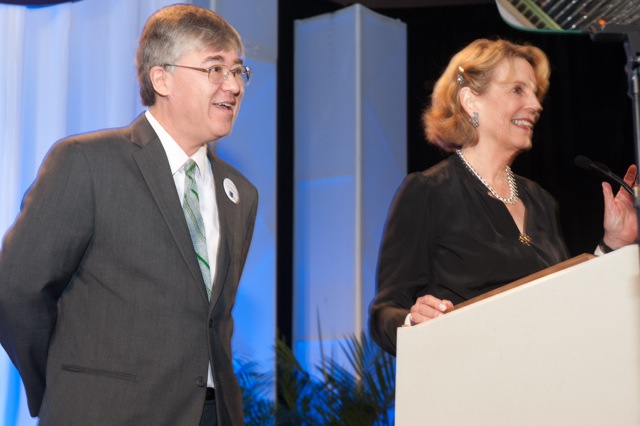
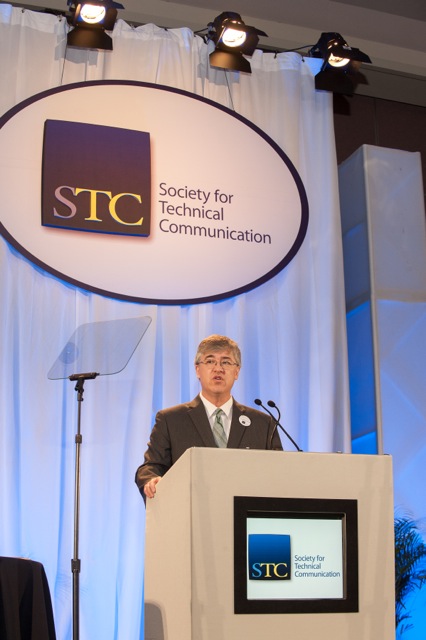
Speaking at the Opening General Session
For the second year in a row I was privileged to address the opening general session (photo courtesy STC)

Over the past year our volunteers have spent countless hours developing a solid, high-quality credentialing program that benefits you as a practitioner and elevates our profession as a whole. Today is an important day for the profession and for the Society. Today, we introduce the first practitioners who have taken this important step and made a difference in their careers by earning the Certified Professional Technical Communicator™ credential…

Now, let’s take a moment to recognize the first CPTC™ certificants. I’m happy to say that some of our certificants are with us this evening, and I’m delighted to invite them up to receive the first CPTC™ certifications!”

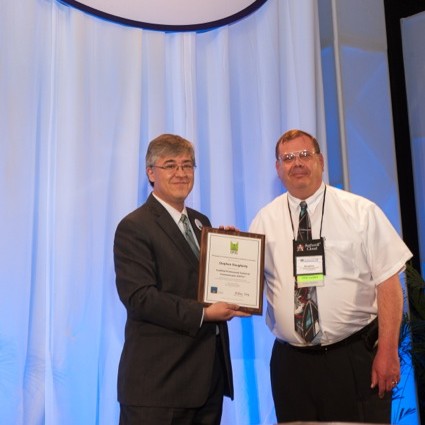
Stephen Daugherty
Stephen Daugherty, CPTC (photo courtesy STC)
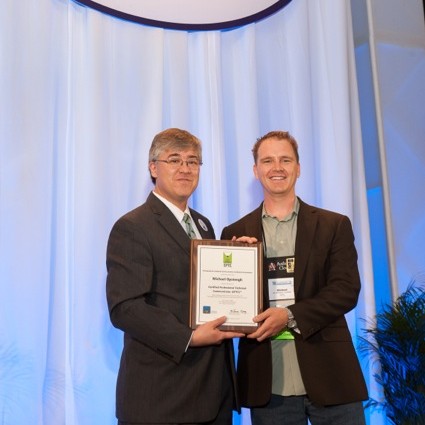
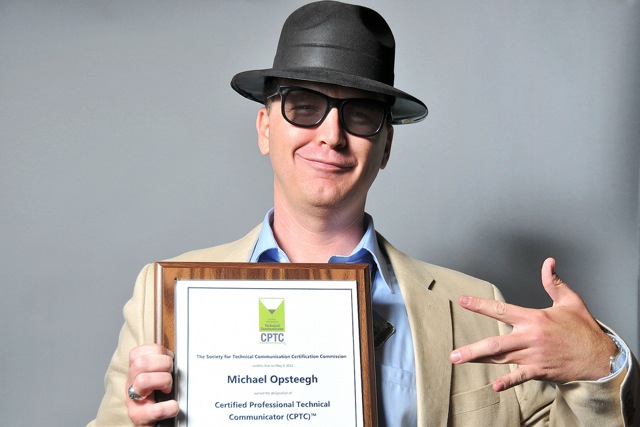
Michael Opsteegh
Michael Opsteegh, CPTC (photo courtesy STC)
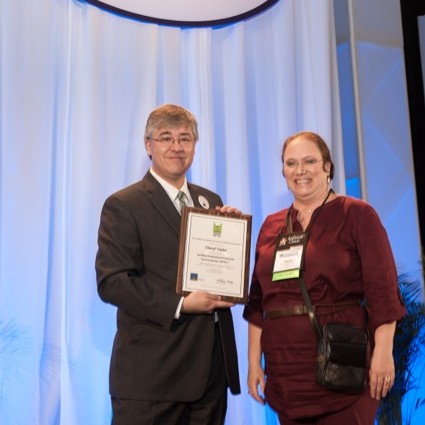
Cheryl Taylor
Cheryl Taylor, CPTC (photo courtesy STC)

For each of the eight charter recipients we displayed a slide with their name and photo. For the three who were actually in the audience, we put their certificates into plaques for the formal presentation. The first few people I named weren’t at the Summit. But Stephen Daugherty was, and he became the first person to receive a CPTC™ certificate, followed by Michael Opsteegh and Cheryl Taylor. We hadn’t had the chance to rehearse this part, but I think it went well.

(Rookie presenter mistake: I forgot to let Stephen and Cheryl hold their plaques for the photos. Michael, who evidently has a little more experience in these matters, grabbed it.) We also made up a supply of buttons for their conference badges, and I handed one to each of them along with their plaques.

I was deeply gratified by the audience’s warm reaction and support. From the look on their faces, I can tell that Stephen, Michael, and Cheryl felt the same way. Me? I get terribly self-conscious smiling for a photo, so you can’t tell from looking, but I was very happy for them, and very satisfied to know that five years of effort on my part, and literally a generati0n of work by a succession of STC volunteers, had come to fruition.

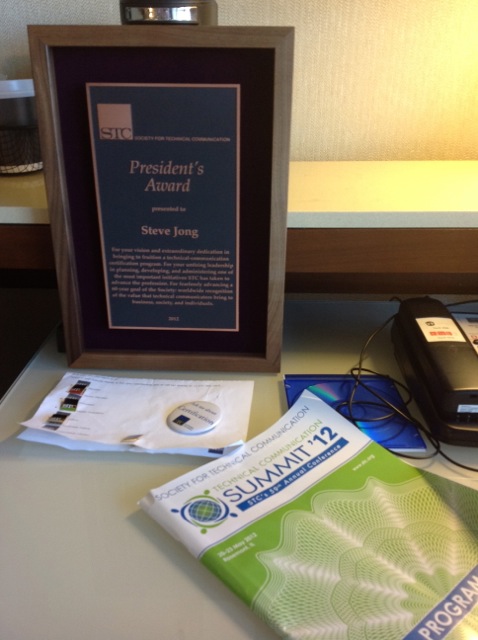
When I finished my prepared remarks I started to leave the stage. But I noticed the TelePrompTer scroll up “Steve ad lib,” which wasn’t in the rehearsal script… Then STC President Hillary Hart, who had been standing to one side during the presentation, unexpectedly called me back to the podium. When she started to describe the President’s Award, I realized she was talking about me.

President's Award announcement
Surprise! Hillary Hart had something for me as well (photo courtesy STC)


(Turns out Steve Skojec had prepared two sets of scripts, and two sets of slides, to keep me in the dark about the award while I was at the rehearsal. Sneaky! The staff went so far as to post a lookout at the door while they rehearsed the actual award presentation. And boy, did he let me know afterwards about the extra work they went through 8^)

Some people have asked me if I knew I was going to get the award in advance. I did not. I’ll tell you, though: while it may have my name on it, without the work of all the volunteers and staff associated with the Commission—some of whom I’ve mentioned here but more of whom I haven’t—my name would never have crossed Hillary’s mind.


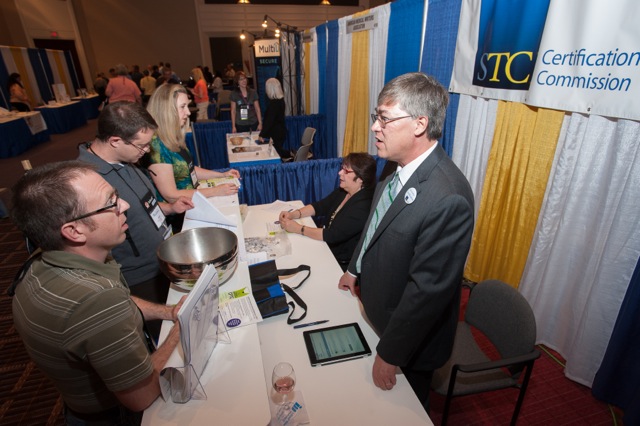
After the keynote speaker finished the action moved to the welcome reception in the exhibit hall, where the Certification Commission had a booth. That first evening was a happy blur, but over the course of the next two days fellow commissioner Karen Baranich, my friend Taryn Light, I, and others logged quite a few hours at that booth.

Commission booth at the exhibit hall
Commissioner Karen Baranich and I staffing the Commission booth in the exhibit hall (photo courtesy STC)

Throughout the conference I saw people approaching Stephen, Michael, and Cheryl to congratulate them, which made them very happy. Me too!

Michael Opsteegh poses with his plaque
The recipients were delighted to show off their accomplishment at every opportunity during the Summit (photo courtesy STC)
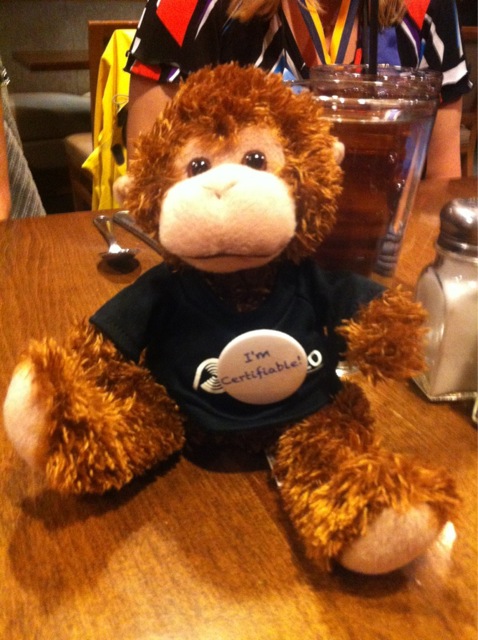
Stuffed bear with "I'm certifiable!" pin
In large and small ways, we generated certification buzz

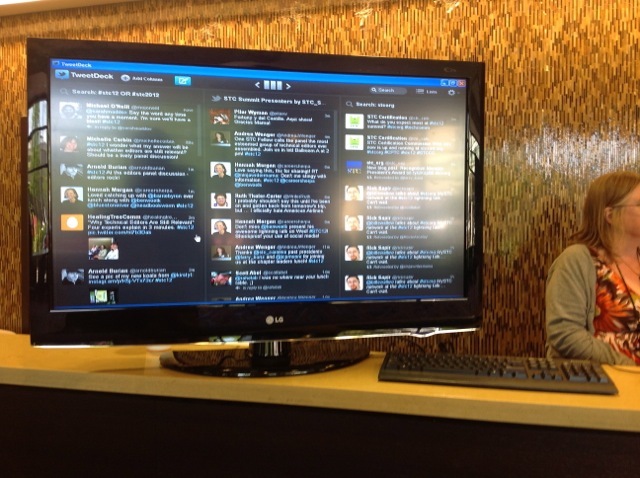
We were collectively sucessful at generating buzz about certification, in both large and small ways. Believe me, I noticed! Here’s a small example. Meanwhile, Debra Zhang, a Boston University graduate student and energetic marketing intern, was  steadily tweeting about certification-related events. A monitor outside the exhibit hall  ran TweetDeck during the conference, and it seemed that every time I walked by she had just posted something. (Two of her tweets, the ones with the CPTC™ logo,  appear in the upper right of the display below.) Even better, other people were tweeting us up as well.

Certification traffic on TweetDeck
Our crack marketing team kept up a steady flow of tweets


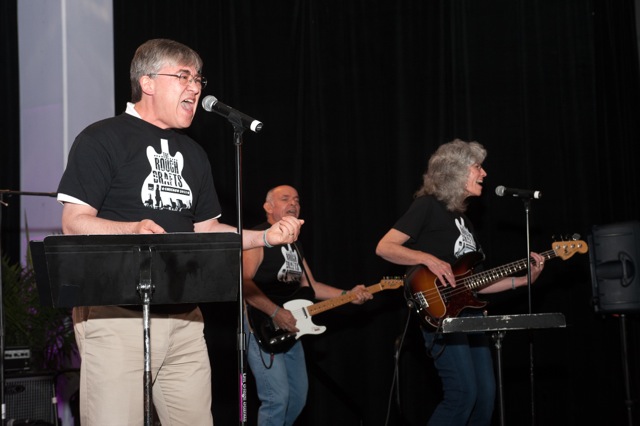
Not apropos of certification, but a personal highlight, was participating in the return, after a four-year hiatus, of the Music Jam on Monday night, which gave me another chance to perform with the Rough Drafts (founders Tommy Barker and Rich Maggiani, new member Viqui Dill, and guest Robert Hershenow). How seriously do I take my music? At lunch on Monday I went over the lyrics of “I Saw Her Standing There” to make sure I didn’t forget anything (as if…!). It was the same stage I’d been on, um, the night before, but for me it was just as much fun the second time!

The return of the Open Jam
Singing at the Music Jam with the Rough Drafts (shown: Tommy Barker and Viqui Dill) (photo courtesy STC)

I wasn’t done yet. The Certification Commission had three presentation slots during the conference: a ten-minute mini-session at STC Central in the exhibit hall; my Tuesday presentation (“What is Certification?“); and Vice-Chair Rob Hanna’s thorough presentation (“How Do I Get Certified?“) on Wednesday. We had also prepared a brief video, produced by Jared Rushanan, that condensed my presentation and ran at STC Central during the conference. I thought all our live presentations went very well, and am encouraged that the versions posted to SlideShare.net have since received more than 1,500 views between them!

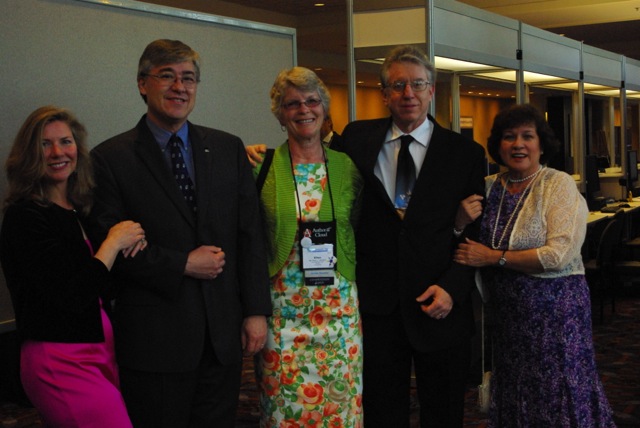
At the pre-Banquet reception
Nearly off the clock…! With some Boston friends at the reception before the Honors Banquet (L to R): Helen Stavely, Steve, Ellen Lidington, Rick Lippincott (New England Chapter president), and Taryn Light

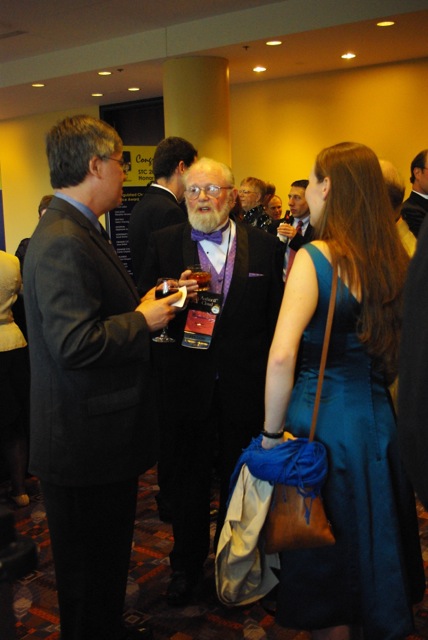
At the Honors Banquet on Tuesday night, I met Andrew Malcolm, a former STC secretary and past head of the STC Certification Task Force from 1982 to 1986. Andy was one of the many who kept the certification flame alive, and he was gracious in congratulating us on reaching the end of a road that he had moved us so far along.

Andrew Malcolm
Speaking with Andy Malcolm, head of the STC Certification Task Force in the 1980s (photo courtesy STC)

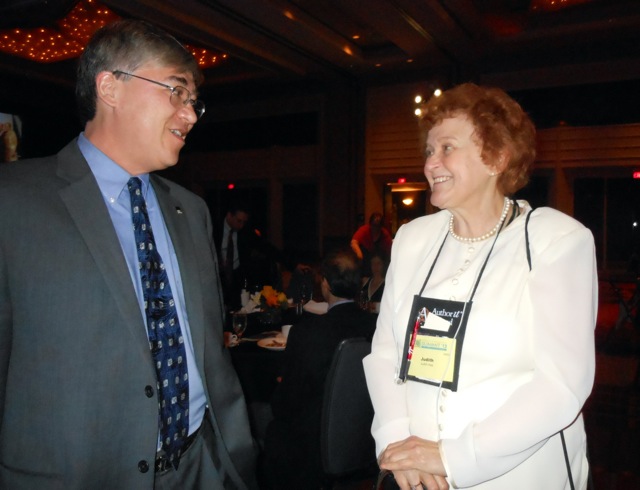
Finally, this is how well things went: during the banquet W. C. Weise introduced me to Judith Hale, president of the International Society for Performance Improvement (ISPI). She congratulated us on our certification program, and as we were chatting I remembered where I’d heard her name:

Steve with Judith Hale, ISPI president
Speaking with Judith Hale, president of ISPI (photo courtesy STC)


“Didn’t you write a book on certification?” Yes, she said, she had.

“Wasn’t it titled Performance-Based Certification?” Why yes, it was.

“That’s the book we used to plan our certification program!”

I mean, how often do you think to say the exact right thing?

Beta testers wanted for Certification Commission website

The STC Certification Commission is working on a website, and could use some beta testers. I’m not talking about beta-testing certification itself, but the website that provides information about certification and from which applicants can apply.

If you’re interested in helping out with beta testing, or if you’re interested in volunteering to help build out the site and its contents, please contact me directly. I thank you in advance!

Passwords and humanism

Anyone with an active Web life has a lot of online accounts. I have over 100! Most are trivial, but some involve credit-card information, and a few are critical in my life. Keeping track of them has gradually become an issue, and the potential damage of getting hacked grows. For the new year, when I log in to an online account, I am strengthening my passwords. I want to follow a system that I can remember without having to write anything down. But I think it’s impossible, because the people who create sites operate independently and because software is anti-humanistic, at least in the view of this human writer. I will explain, while attempting not to reveal my secrets.

Continue reading “Passwords and humanism”